 LV
In short
Dubai is the world's largest branded residence market, with 175 schemes tracked by Knight Frank in 2026, more than double Miami's count. On the DLD registry, the 12-month median premium is +35% in Downtown Dubai, +20% in Business Bay and +4% on Palm Jumeirah. It holds where the brand truly operates the building.
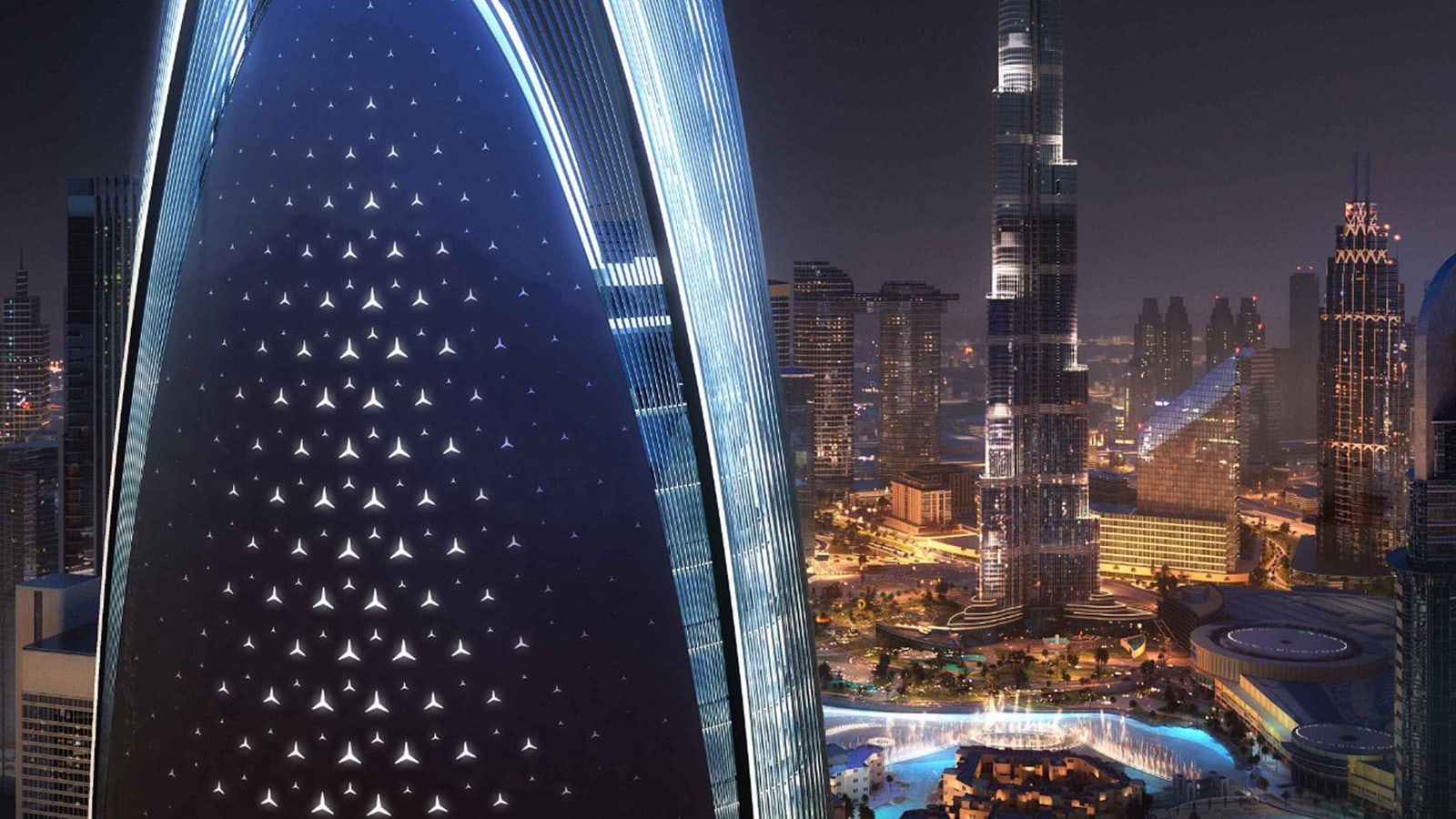
The lit logo at the top of the facade, a doorman opening the glass, a triple-height lobby and a spa on the amenity floor: in Downtown Dubai a branded residence announces itself before you step inside. What the facade does not say is what that name costs, or whether it resells.
A branded residence is a residential property that carries the name of a hotel or lifestyle brand: Address, St. Regis, Four Seasons, Bulgari, Armani. The buyer holds full freehold ownership, with a title deed registered at the Dubai Land Department.
In well-structured projects the brand does more than lend its name. It sets build standards, designs the service layer (concierge, spa, in some cases in-residence dining) and, above all, operates the building after handover.
That is where the distinction that really matters sits: a developer group's own name, or one of its product lines, does not make a branded residence. It takes a hotel or lifestyle operator bringing standards, services and management, under a contract that commits it over time.
Dubai dominates this segment by a wide margin. Knight Frank's census (The Residence Report 2026/27) counts 175 branded schemes, 68 already completed and 107 in the pipeline, more than double Miami's 73, the second-largest city market. The UAE alone accounts for 19% of the global pipeline. The count covers schemes tied to a recognised brand that sets standards and services under a long-term agreement: not only towers, but villas and communities too, and the screen is on the luxury segment.
The model was built at scale here: Emaar developed entire districts around its own hospitality brands, from Address to Vida, and the international luxury operators followed, from Downtown Dubai to Palm Jumeirah.
The registry puts the brand at anywhere from +4% to +35%, by district
For three districts I pulled every apartment sale from the DLD registry over the last 12 months, Unit type, land excluded. Then I isolated the projects identifiable by brand name and compared their median price per square foot with the rest of the district.
| District | Branded (median) | Non-branded (median) | Brand premium |
|---|---|---|---|
| Downtown Dubai | 3,353 AED/sqft (about $914/sqft) | 2,476 AED/sqft (about $675/sqft) | +35% |
| Business Bay | 2,676 AED/sqft (about $729/sqft) | 2,228 AED/sqft (about $607/sqft) | +20% |
| Palm Jumeirah | 2,541 AED/sqft (about $692/sqft) | 2,445 AED/sqft (about $666/sqft) | +4% |
In Downtown Dubai the brand commands its full premium, +35%. Address, Vida, St. Regis and Baccarat are towers run by genuine operators, and the market prices them above everything else in the district.
In Business Bay the average premium is +20%, but two very different markets live inside that figure: they are right below.
On Palm Jumeirah the premium nearly disappears. Not because brands lack value there: the island itself is already a premium product, and the tower's vintage and the individual project matter more than the logo on the facade.
Does the premium pay back twice, or only once?
Within Business Bay, over the same 12 months, the registry lines up two things that share a name and are worth twice as much one as the other.
On one side, Jumeirah Living at 3,596 AED/sqft (about $980/sqft), 61% above the district's non-branded median. On the other, first-generation branded towers, signed by entertainment brands and handed over between 2017 and 2021, now trading up to 36% below that same median.
Both are branded residences on paper. The market treats them as different products. Here is how to tell them apart before signing:
- Operational management: does the brand run the building (staff, maintenance, standards) or did it merely license its name? This is the distinction the registry prices most heavily.
- Track record: does the brand have delivered towers in Dubai, and how have their resale prices held? DLD data answers this project by project.
- Contract: a multi-year management agreement with the hotel operator, or a design-only licence? Ask about duration and renewal terms.
- Service charges: the line items should match the promised services (concierge, spa, hotel-grade common areas, security). Ordinary-tower charges attached to hotel-grade promises are a warning sign, in either direction.
- Rental programme: if the operator offers managed letting, under what rules and with what revenue split?
Five branded residences out of eighteen carry no premium
District averages frame the picture, they do not pick a building. So I changed the question: not what the brand is worth on average, but how many completed branded residences actually trade above their own district.
From the DLD registry I took every completed branded project with a live market, at least twenty apartment sales over the last twelve months, and compared each one's average price per square foot with its district's over the same period. Eighteen projects: thirteen sit above the district average, five sit below.
What matters more than the premium is that it is not automatic. A branded residence costs a certain surcharge on signing day; here you can see that in just under one case in three, once the building exists, the market no longer recognises it.
There is a second result, and it is the one that really changes the method: the same international hotel brand appears twice in this list, trading 66% above the local average in one district and below it in another. Same name, different contract and different building. The premium does not follow the brand: it follows the project.
That is why there is no rule by category. A hotel operator brings staff and standards, but a fashion, design or automotive name can hold value too, when the status is genuinely recognised by the market and the management lives up to it. It happens, and so does the opposite: this is a check to run one tower at a time, looking at what that brand did on the projects it has already delivered. Among those taking the premium in today's registry: The Royal Atlantis on Palm Jumeirah, Five Luxe and Grand Bleu Tower in Dubai Marina, The Address Dubai Opera in Downtown.
The premium is paid today, the benefit arrives later
The premium is paid today and is certain, the benefit comes later and has to be verified. At resale, the markup holds where management is real and standards stay high over the years.
Where the brand was mostly marketing, the market notices and the premium erodes. That is not a flaw in the Dubai market: it is the natural selection of a segment with nearly two decades of local history, which the registry lets you read tower by tower.
A branded residence should be used for what it is: capital protection and premium rents, not the highest percentage yield.
Gross yields from the EJARI registry in the branded districts run at 5% in Downtown Dubai, 4.8% in Business Bay and 4.5% on Palm Jumeirah. A district like Jumeirah Village Circle yields more in percentage terms, 6.4%, but with a different tenant profile, liquidity and value resilience.
Today's percentage is not the whole picture. Where management keeps standards up, rents renew upwards, because premium tenants pay for service before square footage, and that is what defends the resale price too.
There is also an effect many buyers discover afterwards: plenty of branded units exceed 2 million AED (about $545,000), the threshold that, as a natural consequence of the purchase, opens the path to the 10-year Golden Visa.
Frequently asked
What counts as a branded residence in Dubai?
A residential property carrying a hotel or lifestyle brand that sets its standards, services and often its day-to-day management. The owner holds full freehold title, with a title deed registered at the Dubai Land Department.
How much more does a branded residence cost than a comparable apartment?
It depends on the district: on DLD registry data for the last 12 months, the median premium is +35% in Downtown Dubai, +20% in Business Bay and +4% on Palm Jumeirah. At project level the range is far wider.
Is the brand premium recovered at resale?
Where the brand genuinely operates the building, registry data shows prices consistently above the district even for towers delivered years ago. Where the name is only a design licence, the premium tends to erode over time.
Are service charges higher in a branded residence?
Generally yes, because they fund hotel-grade services: concierge, spa, common areas, security. The right question is not how much, but whether the line items match the promised services. Beyond service charges there are no recurring ownership costs.
Does a branded residence qualify for the Golden Visa?
The 10-year Golden Visa applies from a property purchase of 2 million AED (about $545,000). Many branded units naturally exceed that threshold, so the visa comes as a consequence of the purchase rather than a requirement to chase.
Is Dubai really the world's largest branded residence market?
Yes: Knight Frank's 2026 census (The Residence Report 2026/27) counts 175 live and pipeline schemes, more than double Miami's 73. The UAE accounts for 19% of the global pipeline.

Luca Vallelonga
Italian real estate consultant in Dubai since 2021 · Sales Manager at Axia Group · BRN 85642
Who I am and how I work →Found this useful? One a week.
Lettera da Dubai, every Thursday: the DLD registry numbers, the launches worth a look and the ones to skip. One email, nothing else.
Considering a branded residence?
I will measure the real premium on the DLD registry: the project against its district and the brand's track record, and tell you whether the numbers justify it.
Areas mentioned, with registry data